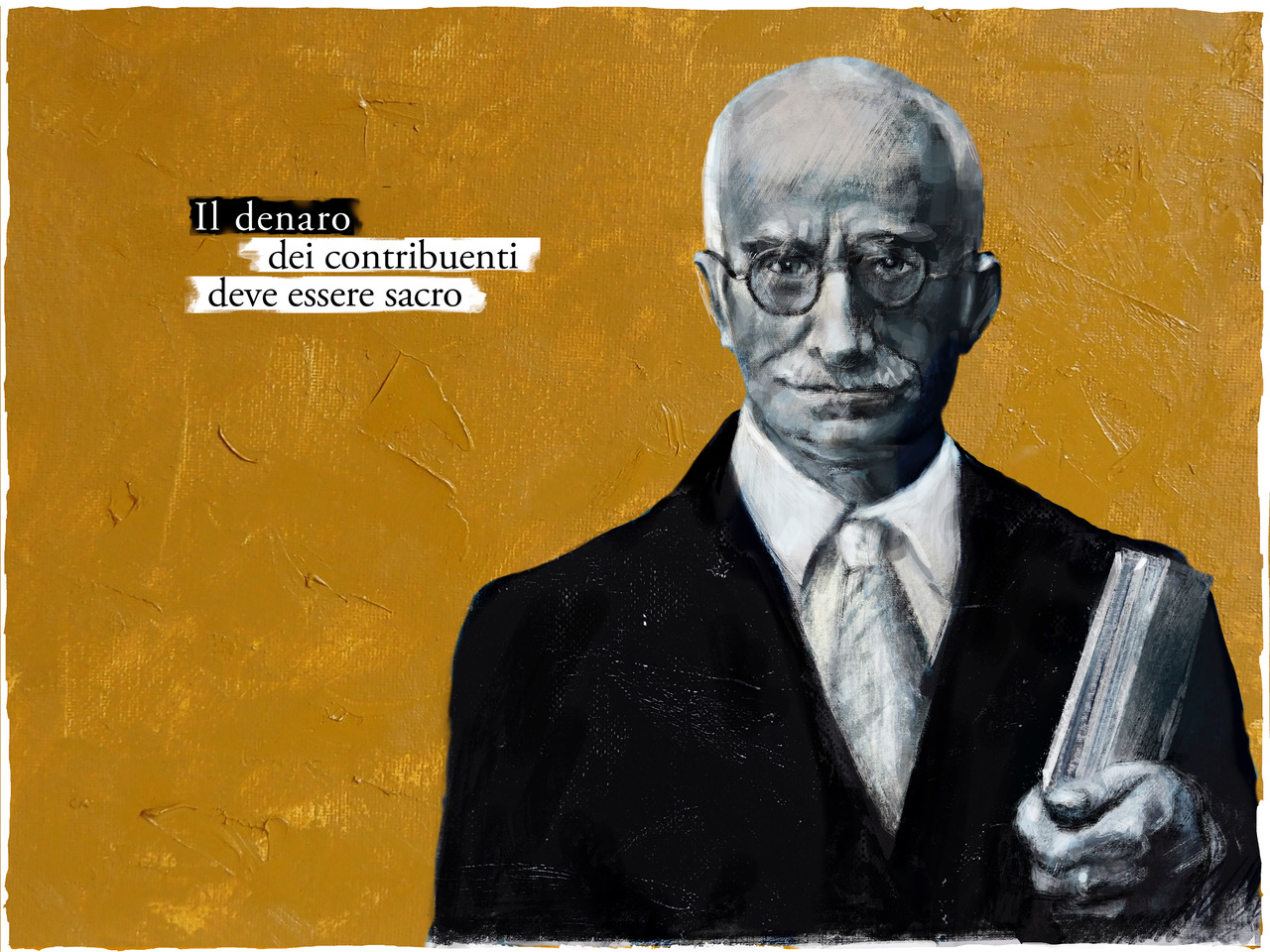
Luigi Einaudi
Carrù (CN), 24 marzo 1874 – Roma, 30 ottobre 1961
Contrario al fascismo, fu costretto a interrompere nel 1935 la sua lunga esperienza alla guida de La riforma sociale; dopo l’8 settembre 1943 riparò in Svizzera, dove maturò e divulgò idee federaliste europee. Promotore del “buon governo” basato sulla responsabilità e la conoscenza, è celebre il suo motto “Conoscere per deliberare”. Dopo il conflitto ricoprì incarichi cruciali nella costruzione democratica: Governatore della Banca d’Italia dal 1945, ministro del Bilancio nel 1947 e infine Presidente della Repubblica dal 1948 al 1955.

Luigi Einaudi
Carrù, March 24th 1874 – Rome, October 30th 1961
Luigi Einaudi was an economist, journalist and politician. He was one of the leading exponents of Italian liberalism and one of the ‘founding fathers’ of the Republic. Born in the Cuneo area, he moved with his family to Dogliani, his mother’s hometown, after his father’s death. It was precisely this rural world of the Langhe, which he knew intimately thanks to his uncle, who was both a farmer and a scholar of local history, that remained a constant point of reference for him, even after he became a university lecturer and an analyst of national economic issues.
An opponent of fascism, he was forced to end his long tenure as editor of La Riforma Sociale in 1935. After 8 September 1943, he fled to Switzerland, where he developed and promoted European federalist ideas. A proponent of ‘good governance’ based on responsibility and knowledge, he is famous for his motto, ‘To know in order to decide’. After the war, he held key positions in the development of democracy: He was Governor of the Bank of Italy from 1945, Minister of the Budget in 1947, and finally President of the Republic from 1948 to 1955.
Luigi Einaudi
Carrù, 24. März 1874 – Rom, 30. Oktober 1961
Luigi Einaudi war Ökonom, Journalist und Politiker. Er gehörte zu den wichtigsten Vertretern des italienischen Liberalismus und zählte zu den „Vätern“ der Republik. Er wurde in der Gegend von Cuneo geboren und zog nach dem Tod seines Vaters mit der Familie nach Dogliani, dem Heimatort seiner Mutter. Gerade diese ländliche Welt der Langhe, die er dank seines Onkels, der Landwirt und Heimatforscher war, aus nächster Nähe kannte, blieb ein ständiger Bezugspunkt für ihn, selbst als er Universitätsdozent und Analyst nationaler Wirtschaftsprobleme wurde.
Als Gegner des Faschismus musste er 1935 seine langjährige Tätigkeit als Herausgeber von La riforma sociale beenden. Nach dem 8. September 1943 floh er in die Schweiz, wo er europäische föderalistische Ideen entwickelte und verbreitete. Als Verfechter einer auf Verantwortung und Wissen basierenden „guten Regierungsführung“ ist sein Motto “Conoscere per deliberare” (Wissen, um zu entscheiden) berühmt. Nach dem Krieg bekleidete er entscheidende Ämter beim Aufbau der Demokratie: Ab 1945 war er Gouverneur der Banca d’Italia, von 1947 an war er Haushaltsminister und von 1948 bis 1955 schließlich Präsident der Republik.

Luigi Einaudi
Carrù, 24 mars 1874 – Rome, 30 octobre 1961
Économiste, journaliste et homme politique, Luigi Einaudi est l’un des principaux représentants du libéralisme italien et l’un des « pères » de la République. Né dans la région de Cuneo, il s’installa avec sa famille à Dogliani, le village natal de sa mère, après le décès de son père. Ce monde rural des Langhe, qu’il connaissait bien grâce notamment à son oncle, agriculteur et spécialiste de l’histoire locale, resta une référence constante dans son regard, même lorsqu’il devint professeur d’université et analyste des problèmes économiques nationaux.
Opposé au fascisme, il dut interrompre en 1935 sa longue expérience à la tête de La Riforma Sociale. Après le 8 septembre 1943, il se réfugia en Suisse, où il mûrit et diffusa des idées fédéralistes européennes. Promoteur de la « bonne gouvernance » fondée sur la responsabilité et la connaissance, sa devise, « Connaître pour délibérer », est célèbre. Après la guerre, il occupa des fonctions cruciales dans la construction de la démocratie : Gouverneur de la Banque d’Italie à partir de 1945, ministre du Budget en 1947, puis président de la République de 1948 à 1955.