

Manzo e Balestra
Augusto Manzo, Santo Stefano Belbo, 20 agosto 1911 – Alba, 25 settembre 1982
Franco Balestra, Tavole, 08 agosto 1924 – Imperia, 3 settembre 2011
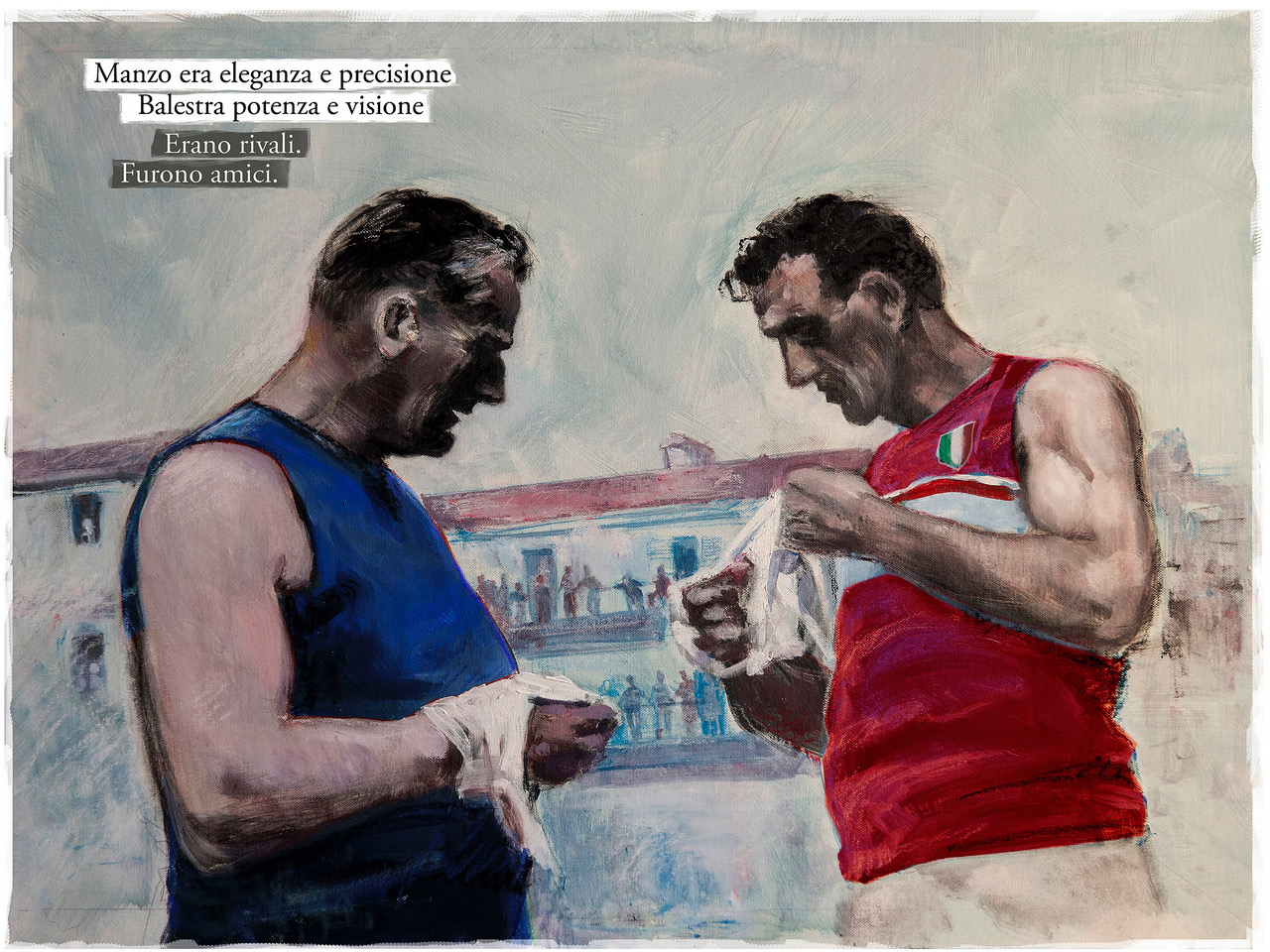
Augusto Manzo e Franco Balestra sono ricordati come le due figure più epiche del pallone elastico, oggi pallapugno: un gioco di squadra radicato tra Langhe e Ponente ligure, giocato nello sferisterio, che per generazioni è stato più di uno sport, un rito di paese e di comunità.
Manzo, battitore di grande potenza e di lettura tattica finissima, dominò soprattutto nel dopoguerra, vincendo più volte il campionato italiano, con una serie straordinaria tra il 1947 e il 1951, e contribuendo anche a tramandare cultura e regole del gioco con scritti e iniziative per i giovani. Balestra, ligure “trapiantato” nelle colline per il balon, ne fu il grande rivale e poi l’erede naturale: campione di stile essenziale e preciso, rimase nella memoria degli appassionati come un “signore” del campo, capace di fare della competizione un modello di lealtà sportiva. Che questa rivalità sia entrata nell’immaginario delle Langhe lo mostra anche Fenoglio: in Il Paese III mette Manzo al centro di una scena da piazza, quando scrive «Quelli del paese già si stringevano intorno al campione. Augusto Manzo, campione italiano di pallone elastico…».

Manzo e Balestra
Augusto Manzo, Santo Stefano Belbo, August 20th 1911 – Alba, September 25th 1982
Franco Balestra, Tavole, August 8th 1924 – Imperia, September 3rd 2011
Augusto Manzo and Franco Balestra are remembered as the two most legendary figures in pallone elastico, now known as pallapugno: a team game deeply rooted in the Langhe and western Liguria, played in the sferisterio, which for generations has been more than just a sport – it has been a village and community ritual.
Manzo, a batter of great power and exquisite tactical insight, dominated particularly in the post-war period, winning the Italian championship several times, with an extraordinary run between 1947 and 1951, and also helping to pass on the culture and rules of the game through writings and initiatives for young people. Balestra, a Ligurian who had ‘relocated’ to the hills for the sake of balon, was his great rival and then his natural successor: a champion of essential and precise style, he remained in the memory of fans as a ‘gentleman’ of the field, capable of making the competition a model of sporting loyalty. That this rivalry has entered the collective imagination of the Langhe is also shown by Fenoglio: in “Il Paese III”, he places Manzo at the centre of a scene in the town square, when he writes, “The villagers were already gathering round the champion. Augusto Manzo, Italian champion of pallone elastico…”.

Manzo e Balestra
Augusto Manzo, Santo Stefano Belbo, 20. August 1911 – Alba, 25. September 1982
Franco Balestra, Tavole, 8. August 1924 – Imperia, 3. September 2011
Augusto Manzo und Franco Balestra gelten als die beiden legendärsten Persönlichkeiten des Pallone elastico, das heute als Pallapugno bekannt ist. Es handelt sich um einen Mannschaftssport, der in den Langhe und im westlichen Ligurien tief verwurzelt ist und im Sferisterio gespielt wird. Seit Generationen ist er mehr als nur ein Sport, nämlich ein Ritual der Dörfer und Gemeinschaften.
Manzo, ein kraftvoller Schlagmann mit feinstem taktischem Gespür, dominierte vor allem in der Nachkriegszeit, gewann mehrfach die italienische Meisterschaft – darunter eine außergewöhnliche Serie zwischen 1947 und 1951 – und trug durch Schriften und Initiativen für die Jugend dazu bei, die Kultur und die Regeln des Spiels weiterzugeben. Balestra, ein Ligurer, der wegen des Ballons in die Hügel umgesiedelt war, war sein großer Rivale und später sein natürlicher Nachfolger. Als Meister eines essenziellen und präzisen Stils blieb er den Fans als “Herr” des Spielfelds in Erinnerung, der den Wettkampf zu einem Vorbild sportlicher Fairness machte. Dass diese Rivalität in das kollektive Bewusstsein der Langhe eingegangen ist, zeigt auch Fenoglio in Il Paese III, wenn er Manzo in den Mittelpunkt einer Szene auf dem Dorfplatz stellt: “Die Dorfbewohner drängten sich bereits um den Champion. Augusto Manzo, italienischer Meister im pallone elastico …“

Manzo e Balestra
Augusto Manzo, Santo Stefano Belbo, 20 août 1911 – Alba, 25 septembre 1982
Franco Balestra, Tavole, 8 août 1924 – Imperia, 3 septembre 2011
Augusto Manzo et Franco Balestra sont restés dans les mémoires comme les deux figures les plus légendaires du pallone elastico , aujourd’hui appelé pallapugno : un sport d’équipe ancré dans les Langhe et l’ouest de la Ligurie, qui se pratique dans le sferisterio. Pendant des générations, il a été bien plus qu’un sport, un véritable rituel villageois et communautaire.
Frappeur d’une grande puissance et doté d’un sens tactique très fin, Manzo a surtout dominé l’après-guerre, remportant plusieurs fois le championnat italien, notamment entre 1947 et 1951, et contribuant également à transmettre la culture et les règles du jeu à travers des écrits et des initiatives destinées aux jeunes. Balestra, un Ligure « transplanté » dans les collines pour le balon, fut son grand rival, puis son héritier naturel. Champion au style essentiel et précis, il est resté dans la mémoire des passionnés comme un « seigneur » du terrain, capable de faire de la compétition un modèle de loyauté sportive. Fenoglio montre également que cette rivalité est entrée dans l’imaginaire collectif des Langhe : dans Il Paese III, il place Manzo au centre d’une scène de place publique, lorsqu’il écrit : « Les gens du village se pressaient déjà autour du champion. Augusto Manzo, champion italien de pallone elastico… »