

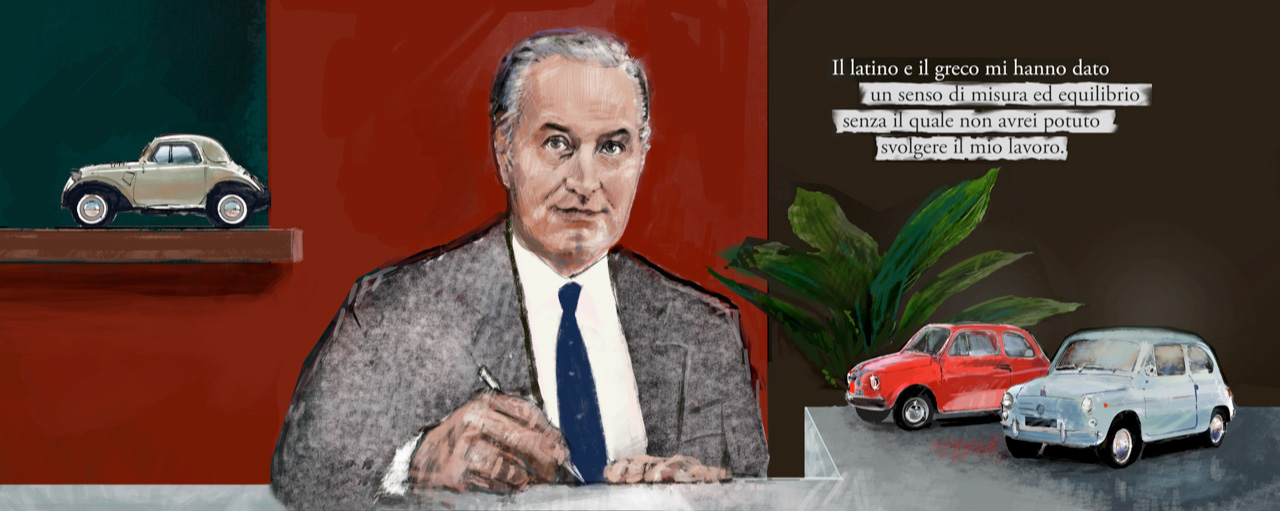

Dante Giacosa
Roma, 3 gennaio 1905 – Torino, 31 marzo 1996
Dante Giacosa, ingegnere meccanico e progettista, è tra i protagonisti della storia industriale italiana del Novecento. Nato a Roma da genitori piemontesi originari di Neive, trascorse l’infanzia nelle Langhe e proseguì gli studi classici ad Alba. Dopo la laurea al Politecnico di Torino nel 1927 entrò in FIAT e assunse incarichi di crescente responsabilità, guidato dall’idea che innovazione e semplificazione dovessero procedere insieme e che lo stile fosse anzitutto armonia di forme funzionali.
Fu tra i principali artefici della motorizzazione di massa: dal progetto della Fiat 500 Topolino nel 1936 fino alla Fiat 600 nel 1955 e alla Nuova 500, esempio di compattezza ed economia d’esercizio, premiata con il Compasso d’Oro nel 1959. Negli anni successivi promosse soluzioni che avrebbero fatto scuola, come l’architettura a trazione anteriore e, con l’Autobianchi Primula nel 1964, l’impostazione a due volumi con motopropulsore trasversale, aprendo la strada alla moderna generazione di utilitarie.

Dante Giacosa
Rome, January 3rd, 1905 – Turin, March 31st, 1996
Dante Giacosa, a mechanical engineer and designer, was one of the most important figures in 20th-century Italian industrial history. Born in Rome to Piedmontese parents from Neive, he spent his childhood in the Langhe and studied the classics in Alba. After graduating from the Politecnico di Torino in 1927, he joined FIAT, taking on roles of increasing responsibility.
Guided by the belief that innovation and simplification should go hand in hand, he considered style to be, above all, a harmony of functional forms. He was one of the key figures in the mass production of cars, from designing the Fiat 500 Topolino in 1936 to the Fiat 600 in 1955 and the Nuova 500, a compact and economical model that won the Compasso d’Oro award in 1959. In the following years, he championed pioneering solutions such as front-wheel drive and the two-box layout with a transverse powertrain, as seen in the Autobianchi Primula in 1964, paving the way for the modern generation of small cars.

Dante Giacosa
Rom, 3. Januar 1905 – Turin, 31. März 1996
Dante Giacosa, Maschinenbauingenieur und Konstrukteur, zählt zu den prägenden Persönlichkeiten der italienischen Industriegeschichte des 20. Jahrhunderts. Er wurde in Rom als Sohn piemontesischer Eltern, aus Neive, geboren, verbrachte seine Kindheit in den Langhe und absolvierte sein klassisches Gymnasium in Alba.
Nach seinem Abschluss am Politecnico di Torino im Jahr 1927 trat er bei FIAT ein und übernahm Aufgaben mit zunehmender Verantwortung. Dabei ließ er sich von der Idee leiten, dass Innovation und Vereinfachung Hand in Hand gehen müssten und Stil in erster Linie die Harmonie funktionaler Formen sei. Er gehörte zu den Hauptakteuren der Massenmotorisierung: vom Entwurf des Fiat 500 Topolino im Jahr 1936 über den Fiat 600 im Jahr 1955 bis hin zum Nuova 500, der 1959 mit dem Compasso d’Oro ausgezeichnet wurde und ein Beispiel für Kompaktheit und Wirtschaftlichkeit ist. In den folgenden Jahren förderte er wegweisende Lösungen wie die Frontantriebsarchitektur und mit dem Autobianchi Primula im Jahr 1964 die Zwei-Volumen-Konfiguration mit quer eingebautem Antriebsstrang. Damit ebnete er den Weg für die moderne Generation von Kleinwagen.

Dante Giacosa
Rome, 3 janvier 1905 – Turin, 31 mars 1996
Dante Giacosa, ingénieur en mécanique et concepteur, est l’une des figures marquantes de l’histoire industrielle italienne du XXème siècle. Né à Rome de parents piémontais, originaires de Neive, il a passé son enfance dans les Langhe et il a suivi des études classiques à Alba.
Après avoir obtenu son diplôme au Politecnico di Torino en 1927, il entra chez FIAT et assuma des fonctions aux responsabilités croissantes, guidé par l’idée que l’innovation et la simplification devaient aller de pair et que le style était avant tout une harmonie de formes fonctionnelles. Il fut l’un des principaux artisans de la motorisation de masse, du projet de la Fiat 500 Topolino en 1936 à la Fiat 600 en 1955 et à la Nuova 500, exemple de compacité et d’économie d’exploitation, récompensée par le prix Compasso d’Oro en 1959. Au cours des années suivantes, il a promu des solutions qui allaient faire école, comme l’architecture à traction avant et, avec l’Autobianchi Primula en 1964, la configuration à deux volumes avec moteur transversal, ouvrant la voie à la génération moderne de petites voitures.