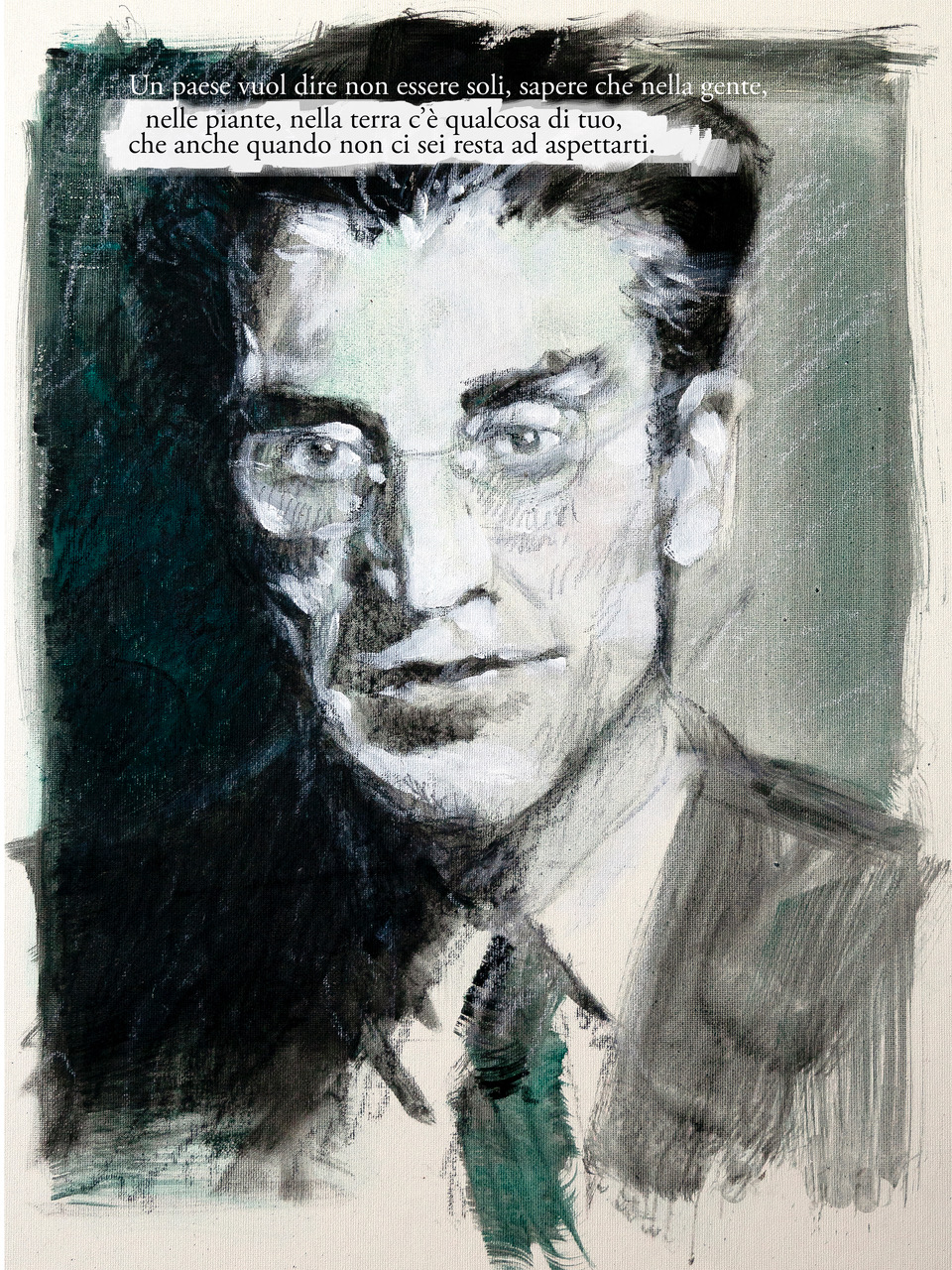
Cesare Pavese
Santo Stefano Belbo, 9 settembre 1908 – Torino, 27 agosto 1950
Poeta, narratore, traduttore e critico, è un protagonista della letteratura italiana del Novecento.
Nato in Langa e legato fin dall’infanzia ai paesi e alle colline della Valle Belbo, visse soprattutto a Torino, dove si formò e lavorò nel mondo editoriale, contribuendo al rinnovamento culturale del dopoguerra. In anni segnati da scelte difficili mantenne contatti con ambienti antifascisti, circostanza che gli costò l’arresto e il confino.
Dopo la Liberazione partecipò con impegno alla vita culturale e civile del Paese. Esordì in poesia con Lavorare stanca (1936) e divenne presto una voce centrale della narrativa con opere come Paesi tuoi (1941). Nel secondo dopoguerra pubblicò Dialoghi con Leucò (1947) e, nel 1950, La luna e i falò, dove le Langhe diventano il luogo del ritorno e della misura interiore: un paesaggio che conserva tracce, legami e memoria. Nello stesso anno vinse il Premio Strega con La bella estate; pochi mesi dopo morì suicida a Torino.

Cesare Pavese
Santo Stefano Belbo, 9 September 1908 – Turin, 27 August 1950
He was a poet, novelist, translator and critic, and a leading figure in 20th century Italian literature. Born in the Langhe area, he had strong ties to the villages and hills of the Belbo Valley from his childhood. He lived mainly in Turin, where he studied and worked in publishing, contributing to the cultural renewal of the post-war period. During a period of difficult choices, he maintained contact with anti-fascist circles, which resulted in his arrest and internment.
After the Liberation, he played an active role in the country’s cultural and civic life. He debuted in poetry with Lavorare stanca (1936) and soon became a prominent fiction writer, producing works such as Paesi tuoi (1941).
During the post-war period, he published Dialoghi con Leucò (1947) and La luna e i falò (1950), in which Langhe become a place of return and inner reflection, a landscape that preserves traces, connections, and memory. In the same year, he won the Strega literary Prize for La bella estate. A few months later, he took his own life in Turin.

Cesare Pavese
Santo Stefano Belbo, 9. September 1908 – Turin, 27. August 1950
Als Dichter, Erzähler, Übersetzer und Kritiker ist er eine der prägenden Figuren der italienischen Literatur des 20. Jahrhunderts. In der Langa geboren und seit seiner Kindheit mit den Dörfern und Hügeln des Belbo-Tals verbunden, lebte er vor allem in Turin, wo er seine Ausbildung absolvierte, im Verlagswesen tätig war und so zur kulturellen Erneuerung der Nachkriegszeit beitrug. In Jahren, die von schwierigen Entscheidungen geprägt waren, hielt er Kontakt zu antifaschistischen Kreisen, was ihm Verhaftung und Verbannung einbrachte.
Nach der Befreiung engagierte er sich intensiv im kulturellen und zivilgesellschaftlichen Leben des Landes. Sein Debüt als Dichter gab er mit Lavorare stanca (1936) und wurde bald zu einer zentralen Stimme der Belletristik mit Werken wie Paesi tuoi (1941). In der Nachkriegszeit veröffentlichte er Dialoghi con Leucò (1947) und 1950 La luna e i falò, in dem die Langhe zum Ort der Rückkehr und der inneren Besinnung werden – eine Landschaft, die Spuren, Verbindungen und Erinnerung bewahrt. Im selben Jahr gewann er den Premio Strega mit La bella estate. Wenige Monate später nahm er sich in Turin das Leben.

Cesare Pavese
Santo Stefano Belbo, 9 septembre 1908 – Turin, 27 août 1950
Poète, romancier, traducteur et critique, il est l’une des figures majeures de la littérature italienne du XXe siècle. Né dans la région de Langhe, il est resté attaché toute sa vie aux villages et aux collines de la vallée de Belbo. Il a principalement vécu à Turin, où il a fait ses études et travaillé dans le monde de l’édition, contribuant ainsi au renouveau culturel de l’après-guerre. Au cours d’années marquées par des choix difficiles, il a entretenu des contacts avec les milieux antifascistes, ce qui lui a valu d’être arrêté et assigné au confinement.
Après la Libération, il s’est activement engagé dans la vie culturelle et civile du pays. Il fait ses débuts en poésie avec Lavorare stanca (1936) et devient rapidement une figure centrale de la fiction avec des oeuvres telles que Paesi tuoi (1941). Après la Seconde Guerre mondiale, il publie Dialoghi con Leucò (1947), puis La luna e i falò en 1950. Dans ce dernier ouvrage, les Langhe deviennent le lieu du retour et de la mesure intérieure : un paysage qui conserve des traces, des liens et la mémoire. La même année, il remporta le prix Strega avec La bella estate. Quelques mois plus tard, il se suicida à Turin.